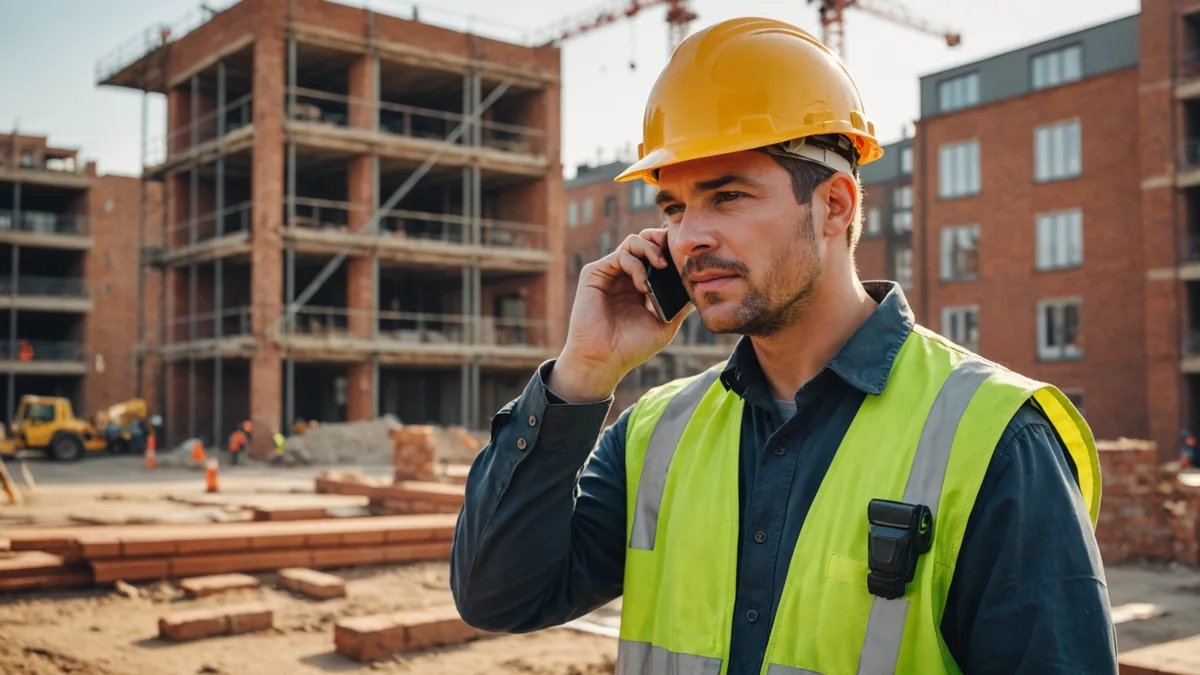
Construction procurement software has existed for decades. Online ordering portals from major builders merchants have been live for years. Yet the dominant channel for getting a materials quote at most UK SME contractors is still a phone call to an account rep. This is not a story about technology lagging adoption. It is a story about why the phone call continues to win on the criteria that matter most to the people using it.
Understanding why the phone persists is more useful than criticising it. If you want to build something that genuinely replaces it, you have to reckon with what it actually does well, not just with what makes it look inefficient from the outside.
The phone call resolves ambiguity fast
Most materials orders involve some degree of specification ambiguity that a contractor needs to resolve before placing the order. The dense aggregate block needed for a particular internal partition may have three or four comparable product options from a given merchant. The right choice depends on availability, current price, whether the supplier can deliver the needed quantity in one load, and whether there are any known quality issues with the current batch from a particular manufacturer.
A phone call to a rep who knows the account can resolve all of these questions in two minutes. An online portal shows you a catalogue. It does not tell you that the listed product is currently on allocation because of a supply constraint, that the alternative is actually better suited to your application, or that if you order before midday the lorry can be with you tomorrow.
The phone call is an information-dense channel that surfaces context that is simply not available in a digital catalogue. Until digital procurement tools can match that contextual information density, the phone will remain competitive for orders where specification decisions are not cut and dried.
Supplier relationships are built and maintained through conversation
A contractor who has worked with the same account rep at a regional merchant for four or five years has a relationship that carries real commercial value. That rep knows which projects are in the pipeline, understands the firm's typical order patterns, and will often do things outside the formal service model: call ahead when a price is about to change, hold a small stock allocation during a tight period, expedite a delivery when a programme is under pressure.
That relationship does not get maintained through a web portal. It requires ongoing human contact. The phone call is the lowest-friction way to maintain that contact in the flow of normal work. A contractor who switches to purely digital ordering with a supplier they have an existing relationship with is, in effect, declining to maintain the relationship, and over time the special service level that came with it diminishes.
We are not saying this is economically optimal. We are saying it is a rational response to how supplier relationships in UK construction actually work. The value of the relationship is real, and the phone is the tool that maintains it.
The trust gap with unfamiliar digital tools
Construction site managers and foremen tend to be pragmatic people whose trust in a tool is earned through reliable performance, not through a feature list. Many of the procurement portals that have been built for construction have failed on basic reliability grounds: prices that are not up to date, delivery windows that are not honoured, customer service that is slower than calling directly when something goes wrong.
When a digital tool fails once on a critical order, it gets removed from the active toolset and is not easily reinstated. The phone call has a very different failure mode. When a call-based order goes wrong, the rep who took the order is personally accountable in the next conversation. That accountability structure is one that contractors understand and can work within. A failed digital order goes to a support ticket queue with no named person holding the problem.
This is a trust and accountability argument, not a technology capability argument. The digital tools that have broken through in construction have done so by matching the accountability characteristics of the human channel: named reps, direct message threads, someone who owns your problem when it goes wrong.
The workflow does not match the digital model
Most procurement portals are designed around a search-and-basket model that assumes the buyer has a clear specification, knows what they want to order, and is ready to place a defined order in a single session. That model works for commodity items where the specification is fixed and the decision is purely about price and delivery timing.
A significant proportion of materials orders on a construction site do not start from that point. They start from a problem: we have run short of this material, we need to reorder, but the spec has been slightly modified and we need to check that the substitution is acceptable, and by the way the delivery access on this site has changed since last time. A phone call handles that kind of multi-dimensional, context-rich interaction naturally. A search portal does not.
The workflow gap is particularly pronounced for smaller orders and urgent orders, which tend to be the highest-frequency transaction type on a busy site. The volume purchase of 500 pallets of facing brick that gets planned two months in advance and price-compared across four suppliers is a case where a structured digital process genuinely helps. The 15 bags of mortar needed tomorrow morning is a case where the phone is almost always faster.
What this means for digital procurement tools
This is not an argument that nothing will change. It is an argument about what needs to change for the phone to be displaced rather than supplemented.
The digital tools that will gain adoption in UK contractor procurement are those that start from the actual workflow rather than from the portal model. That means handling specification ambiguity, not just catalogue search. It means maintaining the relationship context that currently lives in the account rep's head. It means having a response channel for exceptions and problems that matches the accountability of a direct call.
The phone call will persist wherever digital tools fail to match it on those criteria. The opportunity is not to build a replacement. It is to build a tool that is genuinely better on the dimensions contractors care about, while being honest about which dimensions those are.
At Prolo, the work we are doing starts from talking to contractors about where the phone is frustrating rather than useful: the situations where they wish they had a structured record of what was agreed, or where comparing three quotes requires three separate calls and a memory of what each rep said. Those are the specific gaps where a digital layer adds value without asking people to change the fundamentals of how they work.