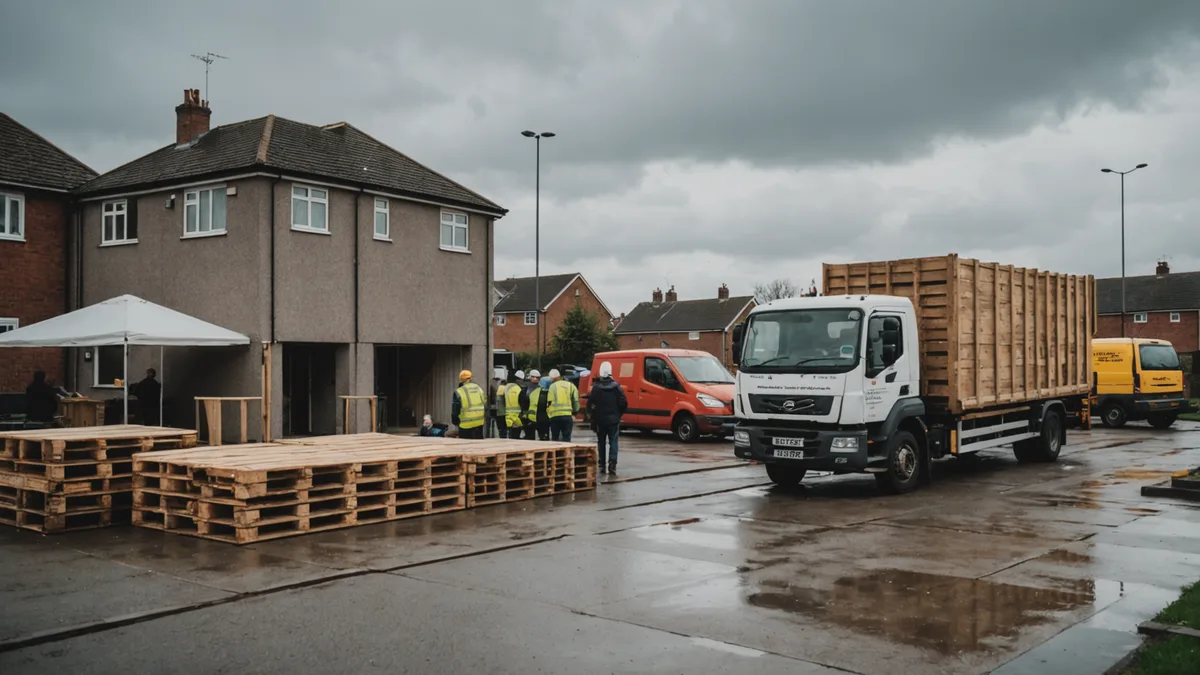
A site manager calls the merchant at 8:15 AM to confirm a block delivery. The merchant tells them the product line has been discontinued. The alternative they suggest is a different density rating, and it costs 12% more. The site manager has fifteen minutes to decide because the bricklayers are already on site and the day needs to start. That decision, made with no reference to the architect's spec or the structural engineer's notes, will not be reviewed until snagging.
This scenario plays out regularly across UK residential and commercial sites. The question is not whether it will happen. It is whether you have a process for handling it when it does, or whether you are improvising under pressure every time.
Why substitution is structurally harder than it looks
The surface-level problem is availability: a product is not in stock and you need something that works. But the real problem is that most substitutions have approval dependencies that a time-pressured site manager cannot always resolve in a morning slot.
Structural materials, particularly blocks, lintels and concrete products used in load-bearing applications, often have specifications tied to planning conditions or structural engineer's calculations. Substituting a product with a different compression rating or density class is not a like-for-like swap, even if it looks similar. If the substitution happens without sign-off and it is noticed at building control inspection, you are looking at remediation that far exceeds any cost saving from sourcing quickly.
Finishing materials create a different kind of problem. A facing brick going out of stock mid-project on a development where the first four houses have already had 60% of their external skin laid means every subsequent batch needs to either match exactly or be sourced from a different run that may blend differently under UV exposure. Colour inconsistency across a terrace is a defect that surfaces slowly and is very visible once it does.
Insulation products carry their own substitution risks. Different manufacturers' products at nominally the same U-value may have different thickness requirements for compliance, and if wall construction has been specified tightly for party-wall or external-wall build-up, swapping in a product that requires an extra 10mm throws out fire-stopping details, junction designs and sometimes window reveal depths.
The substitution decisions that go badly
Most substitution decisions that cause problems fall into three categories.
The first is unilateral on-site approval. The foreman picks an alternative, gets it delivered, and the project continues. Nobody checks the spec sheet. The substituted product may be perfectly adequate in the application, or it may have performance characteristics that differ materially from the original. Without a record of what was changed and why, there is no way to audit it later.
The second is supplier-led substitution. The merchant says "this is our equivalent product" and sends it without any detailed specification review. Merchants know their product ranges, but they do not know the structural or compliance requirements of your specific project. Their definition of equivalent may not match the designer's definition.
The third is price-led substitution. Under margin pressure, a cheaper alternative gets selected because it is available and in budget. If the cost difference comes from a lower-grade product rather than a different sourcing channel for the same specification, that saving can come back as a warranty claim or, in worst cases, a building performance failure.
Building a substitution protocol before you need one
The contractors who handle out-of-stock situations best tend to have done a piece of upfront work at the specification stage that most others skip. It is not complicated, but it requires discipline to set up at the start of a project rather than scrambling for it mid-run.
For each category of material in the specification, identify at least one pre-approved alternative before the project starts. The structural engineer or architect can often provide this with minimal additional effort at design stage, especially if they are using a standard specification library. A note in the project folder that says "approved alternative for 100mm dense aggregate block: Product X from Manufacturer Y, same compression class, confirmed by [engineer initials] on [date]" takes thirty minutes to compile and saves hours during a crisis window.
Define who can approve a substitution without a formal variation. For minor finishing materials below a certain value threshold, that might be the site manager. For structural or compliance-relevant materials, it should require the contract administrator or the structural engineer's confirmation in writing, however brief. Having that hierarchy written down means the site manager knows which decisions they can make quickly and which ones need a phone call before the lorry is loaded.
Create a substitution log. It does not need to be complex: a spreadsheet with the original product, the substituted product, the date, the reason, and who approved it. This log matters at practical completion, when the building manual is assembled, and it matters if there are defects to investigate later.
What to do when you are already mid-crisis
If the out-of-stock situation has already arisen and you have no pre-approved alternative, the practical steps are: pause the affected work and do not improvise with an untested substitution for compliance-critical elements; contact the original product manufacturer for an alternative source rather than defaulting to the merchant's first suggestion; get written confirmation from whoever holds design authority before ordering a substitution in a structural or compliance application; and document the substitution regardless of how it is resolved.
For non-structural finishing materials where like-for-like sourcing is the challenge rather than compliance, the priority is getting a sample from the alternative product to confirm visual match before ordering a full quantity. Colour variation between production runs is real, and a small investment in a sample delivery before committing to the full order is almost always worth it.
A note on what this is not
We are not arguing that substitutions are always avoidable or that every out-of-stock situation means a project is badly managed. Supply chain disruptions in construction materials are a real and recurring feature of the current UK market. What we are arguing is that improvised, undocumented substitutions made under time pressure are a compounding risk, not a one-off event, and that a small amount of planning at the start of a project dramatically reduces the cost and risk of handling them when they occur.
One of the things we focus on at Prolo is making the information side of procurement more visible, including flagging when products that are on a contractor's active order list are showing availability constraints across the suppliers we work with. Earlier visibility on stock tightening gives a site more lead time to resolve alternatives through the right channels rather than the fastest channels.
The goal is to turn a crisis call at 8:15 AM into a planned conversation at 4 PM the previous week. That is a process improvement, not a technological miracle. But it is the kind of improvement that protects margins in ways that are difficult to attribute and easy to overlook until you have not done it.