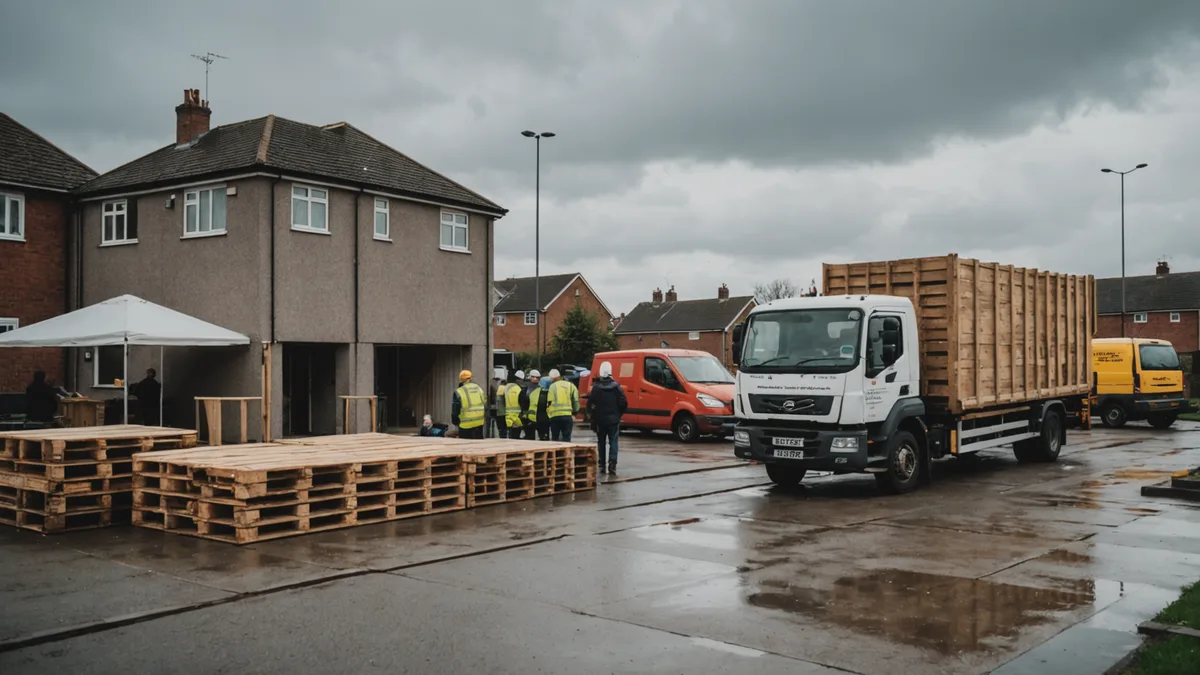
A 30-unit residential development does not have one supplier relationship. It has twelve to eighteen, depending on how tightly materials have been packaged. There will be a blockwork supplier, a facing brick supplier who may or may not overlap with the blockwork account, a timber merchant for floor joists and studwork, a plasticboard supplier, a roofing material merchant, a plumbing and heating distributor, and so on through the trades. Each has their own pricing structure, their own account terms, their own delivery constraints, and their own contact people.
Managing this well is straightforward in principle and genuinely demanding in practice. The question is not whether you can keep track of it. It is what "keeping track" costs you in time and attention, and where the gaps open up when things are moving fast.
What tends to slip first
When a contractor is running a project with 15-plus active suppliers, the things that most commonly slip are not the ones that feel risky. They are the mundane administrative ones that compound silently.
Price agreements negotiated at the start of a project do not automatically hold across the full project duration. A merchant may have agreed a rate on facing bricks in March, but if the next order comes through in July and a new rep has taken over the account, the agreed price may not be on the purchase order. Checking this on every order is reasonable in theory, but in a busy project office it gets skipped. The difference between the agreed rate and the current catalogue price is rarely enough to flag on a single invoice, but across 40 deliveries over a seven-month project, it is not trivial.
Delivery windows agreed at order placement drift over time. A slot booked with a concrete products supplier three weeks out gets confirmed, then the supplier calls to reschedule, and the revised date gets written on a sticky note rather than recorded against the order. When the site manager calls to confirm the day before, there is a miscommunication about which date was the final agreement. The delivery does not arrive. The pour is pushed.
Order history becomes important later in the project when you need to reorder, when you are reconciling final accounts, and when you are resolving disputes about quantities received. If that history is distributed across email, phone logs, WhatsApp messages, and handwritten purchase order books, reconstructing it is slow and often incomplete.
The supplier relationship layer
Beyond the administrative tracking, large projects involve a relationship management dimension that is genuinely time-intensive. Each supplier has someone who looks after your account, and maintaining those relationships well pays back in service quality, priority handling when stock is tight, and flexibility on terms when a project has a cash flow pinch.
The problem is that good supplier relationship management for 15 accounts is close to a full-time function. A procurement manager or senior quantity surveyor might carry it for a large developer, but on a medium-sized main contractor running three or four projects simultaneously, there is often nobody with explicit ownership of those relationships at a project level. The site manager handles the operational day-to-day, the contracts manager handles disputes and final accounts, and the relationship layer in between gets managed informally, which usually means it gets managed inconsistently.
On a project in Leeds that we were tracking through last year, a contracts manager running a 24-unit scheme described spending around six hours a week on supplier communication that he characterised as "relationship maintenance with no clear output." Calls to check on lead times, calls to confirm prices before issuing purchase orders, calls to chase unacknowledged orders. None of it was discretionary in his view. All of it was overhead that the programme made no allowance for.
Practical systematisation that holds up
There are a few structural approaches that consistently reduce the tracking burden for contractors on larger projects, and they are worth spelling out plainly because they do not require expensive software to implement at basic level.
First, create a single procurement register at project start. One document, maintained by one person, that lists every supplier, the account number, the agreed pricing terms, the contact name, and the delivery constraints. This is not a full contract management system. It is a one-page reference that anyone on the project can use. The act of building it at the start forces a price negotiation review that often does not happen systematically otherwise.
Second, require written order confirmations for every order above a threshold. For orders over, say, £500, a written purchase order sent and acknowledged before the delivery is booked. This is standard practice for many contractors but inconsistently applied when site operations are busy. The confirmation creates a record that can be matched against delivery notes and invoices, which is where most quantity and price disputes originate.
Third, assign a single point of contact per supplier rather than allowing multiple people on site to communicate directly with the same account. When the site manager, the foreman, and the contracts manager are all calling the same rep about the same project, information gets fragmented and conflicting instructions get issued. One contact per supplier, all orders and changes through that contact.
Where digital tools add value and where they do not
There is an honest conversation to be had about where procurement software genuinely helps and where it adds process without reducing burden.
The areas where a systematic digital approach genuinely reduces the management load are: price comparison at the point of ordering (which prevents the drift from agreed rates described above), order acknowledgement tracking (which creates a record without manual chase), and delivery scheduling in one place (which prevents the calendar fragmentation that causes missed deliveries).
The areas where software promises more than it typically delivers for a growing contractor are: supplier relationship management (relationships are fundamentally human and no software replaces a good working account relationship), dispute resolution (most invoice disputes need a human conversation to resolve), and procurement strategy (decisions about which suppliers to use, how to package materials, and when to lock in prices are judgment calls that benefit from experience and context that a tool cannot provide).
At Prolo, we are focused on the first set: making the comparison, ordering and delivery coordination layer faster and more reliable. We are not trying to replace the account relationships or the judgment that goes into strategic procurement decisions. The goal is to reduce the volume of low-value communication that currently sits between a contractor and their suppliers, and to put the order history and delivery status in one place rather than five.
The scale threshold where this matters most
It is worth being direct about scale. For a contractor running one or two projects under 10 units each, informal supplier management is probably adequate. The relationships are tight, the contact list is short, and most of the information lives in one person's head without significant leakage.
The threshold where it starts to break down is typically around 15 to 20 units on a single site, or two or more projects running concurrently with shared suppliers. That is when the same supplier is receiving calls from different site teams about different projects, when price agreements need to hold across a longer period, and when the administrative tracking load exceeds what one person can manage alongside operational responsibilities. That is the point at which systematising the procurement layer pays back with compound interest.